When Every Choice Feels Overwhelming: ADHD and Decision Fatigue
by Dr. Liz, June 30, 2025

 Some people have no problem making decisions. They choose an option and move forward. But for people with ADHD,
the decision-making process can quickly become overwhelming. Decision-making is a complex, multi-step process.
They need to figure out their options, compare and contrast them, and think through the consequences of their final
choice. Throw in some anxiety about making a big decision, or a time limit that is forcing their hand, and
the decision making gets even harder.
Some people have no problem making decisions. They choose an option and move forward. But for people with ADHD,
the decision-making process can quickly become overwhelming. Decision-making is a complex, multi-step process.
They need to figure out their options, compare and contrast them, and think through the consequences of their final
choice. Throw in some anxiety about making a big decision, or a time limit that is forcing their hand, and
the decision making gets even harder.
Why Decision-Making Is Harder with ADHD
 There are lots of reasons why indecision is an issue for people with ADHD. I’ve seen my coaching clients
struggle with all kinds of decisions. Sometimes they don’t know what to do first, or don’t understand what
they need to do. Sometimes they get overwhelmed by too many options or get stuck in a never-ending research
spiral looking for the “perfect” answer or solution. Some are afraid of making the “wrong” choice, so they
agonize over it and end up making no choice at all. Whether you call it “analysis paralysis,” “decision fatigue,”
or something else, it can be a real problem for the ADHD brain and its executive function challenges.
There are lots of reasons why indecision is an issue for people with ADHD. I’ve seen my coaching clients
struggle with all kinds of decisions. Sometimes they don’t know what to do first, or don’t understand what
they need to do. Sometimes they get overwhelmed by too many options or get stuck in a never-ending research
spiral looking for the “perfect” answer or solution. Some are afraid of making the “wrong” choice, so they
agonize over it and end up making no choice at all. Whether you call it “analysis paralysis,” “decision fatigue,”
or something else, it can be a real problem for the ADHD brain and its executive function challenges.
Decision Making and Executive Functions
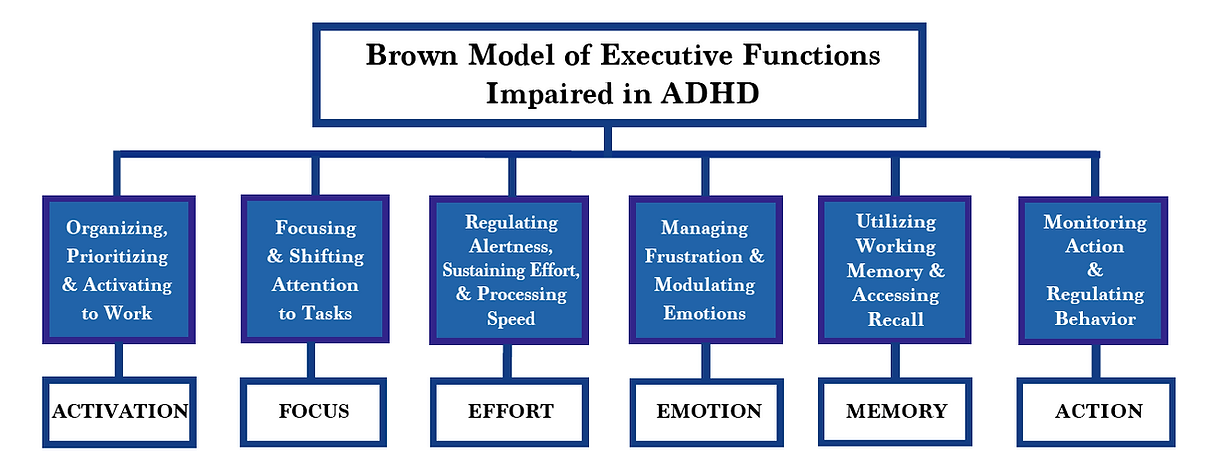 Let’s take as an example something that, for many people, is an easy decision – what to have for dinner. There are many executive
functions involved in making this (or any) decision where the ADHD brain may already be impaired. According to
the Brown model, these include:
Let’s take as an example something that, for many people, is an easy decision – what to have for dinner. There are many executive
functions involved in making this (or any) decision where the ADHD brain may already be impaired. According to
the Brown model, these include:
- Activation: Organizing tasks and materials; prioritizing; getting started on tasks. For example, you may not have all the information you need to make a decision (where are the restaurant menus? Do they have gluten free options? Is there parking nearby? Do they deliver?) If you can’t decide on a place, you can’t decide what to order. Or you stare at the contents of the fridge or pantry and feel overwhelmed. The available food options are not well organized (how old is that pizza? Didn’t I buy salsa?) You don’t know what sounds good or is realistic to make. You can’t decide whether to cook or to get take-out.
- Focus: Focusing, sustaining, and shifting attention to tasks. For example, you try to think through your choices, but you keep getting distracted. Your friends are texting, you’re scrolling through TikTok trying to find a recipe you saw last week, and you started digging through the pantry and now there’s cans and boxes all over the table. Oh wait! Here’s the menu from the Chinese place . . .. It’s hard to stay focused long enough to weigh options when your attention keeps shifting to other tasks or distractions.
- Effort: Regulating alertness, sustaining effort, and processing speed. For example, you had a long day, and you are tired and hungry. Thinking through recipes, ingredients, prep time, and cleanup feels like too much. There are too many menus to scroll through and you’re not even sure what type of food you want. The mental energy required to make the decision feels too high. Processing all your options feels slow and draining. It’s easier to walk away without deciding.
- Emotion: Managing frustration and modulating emotions. For example, you’re annoyed with yourself for not planning ahead. You feel guilty for spending money on takeout again instead of making a healthy meal from ingredients you already bought. Frustration and guilt cloud decision-making. Stress makes the decision harder, and now you’re “hangry.” Your mood impacts your choices or leads to avoiding the decision.
- Memory: Using working memory and accessing recall. For example, you can’t remember what ingredients you have on hand, what you’ve already eaten this week, or which place had those awful burgers. You can’t find that chicken recipe, and the pan you would need is still dirty in the sink from yesterday. It’s a struggle to hold multiple options in your mind at once, and you can’t find a pen and paper to do a pro/con list.
- Action: Monitoring and self-regulating behavior. For example, you start cooking something, then abandon it halfway through for something quicker or because you don’t have all the ingredients you need. You have trouble following through after making the decision to cook. Or you order take-out without checking what’s in the fridge. Impulsivity overrides your goals of saving money or eating healthy.
Why It Matters
 When your executive functions are working together smoothly, decision making is easier. But with ADHD, weakness
in even one area can disrupt the whole process, leading to decision fatigue, avoidance, impulsivity, or
indecision. For some people, having to make frequent small decisions leads to burnout. For others, making big
decisions is overwhelming. Either way, neurodivergent brains may require more effort to make a decision, leading
to mental exhaustion, irritability, and/or shutdown. Decision fatigue can worsen ADHD symptoms, making it harder
to make decisions, and creating a loop of indecisiveness.
When your executive functions are working together smoothly, decision making is easier. But with ADHD, weakness
in even one area can disrupt the whole process, leading to decision fatigue, avoidance, impulsivity, or
indecision. For some people, having to make frequent small decisions leads to burnout. For others, making big
decisions is overwhelming. Either way, neurodivergent brains may require more effort to make a decision, leading
to mental exhaustion, irritability, and/or shutdown. Decision fatigue can worsen ADHD symptoms, making it harder
to make decisions, and creating a loop of indecisiveness.
Strategies for Making Decisions Easier
 There are ways to take the burden off your brain when it is time to make decisions. Here are a few things to try:
- Reduce choices: Create go-to routines to make your choices easier. Spending too much time trying to figure out what to wear? Create a capsule wardrobe where everything matches so no matter what tops and bottoms you grab, you’ll be good to go.
- Create visual aids: Make a pro/con chart to help you decide. Use sticky notes to remind yourself what decisions you’ve already made so you don’t need to make them again. Create a mind map to help you think through all aspects of a decision.
- Use timers: Give yourself a time limit to reduce overthinking. When the time is up, you must make the decision.
- Discuss with someone: Talking a decision through with someone else can help clarify it in your mind. Try a trusted friend, family member, teacher, or coach.
- Use "good enough" thinking: Aim for progress, not perfection. If it is a low stakes decision (Italian or Greek food tonight?), flip a coin!
- Set defaults: Automate decisions when possible – go to the gym Monday/Wednesday/Friday, call Mom on Sunday, do laundry on Saturday, make tacos on Tuesday. Practice until they become habits.
- Limit big/important decisions to high-energy times. Figure out your “power hours” – when are you most productive and able to get things done? This could depend on time of day, when meds kick in, or something else. Your brain will be more ready to make decisions then.
Final Thoughts
Deciding what to eat (or making any other choice) might seem simple, but for an ADHD brain, the executive functions don’t always work smoothly. Each step in the decision-making process can feel harder than it “should.” It’s important to understand how ADHD affects your decision making so you can find strategies to overcome your particular obstacles and become more decisive. The goal isn’t perfect choices, it’s progress, clarity, and a little less overwhelm.
If this article resonated with you, let’s stay connected! Follow me on Instagram
for more ADHD-friendly strategies, encouragement, inspiration, and tips.
Ready to stop spinning your wheels? Learn more about ADHD Coaching and how we can create personalized systems
to help you move forward. If you’re interested, schedule a free 30-minute consultation. You don’t have to do
this alone.
Image Sources
- Decisions Word Cloud: https://www.thedomesticmusician.com/making-decisions-as-a-music-teacher/
- Yes/No/Maybe: https://slcbookkeeping.com/blog/what-do-better-business-decisions-actually-look-like/
- Brown Model: https://www.brownadhdclinic.com/brown-ef-model-adhd
- Woman with Glasses: https://www.spatzmedical.com/blog/the-hidden-language-of-fatigue/
- Man with Questions: https://www.naturalability.com.au/adults
Have a question about ADHD coaching or this post? Contact me here!