The Effects of Stress & Anxiety
on Executive Functioning
by Dr. Liz, March 31, 2024

 Executive Functions (EF) are a set of cognitive skills that allow us to control and self-regulate behavior.
Research shows that up to 90 percent of youth with ADHD struggle with executive dysfunction in some way
(Rodden, 2021). While any brain can have EF strengths and struggles, an ADHD brain usually has more, and more
serious, challenges than a neurotypical brain.
Executive Functions (EF) are a set of cognitive skills that allow us to control and self-regulate behavior.
Research shows that up to 90 percent of youth with ADHD struggle with executive dysfunction in some way
(Rodden, 2021). While any brain can have EF strengths and struggles, an ADHD brain usually has more, and more
serious, challenges than a neurotypical brain.
Importance of EF
 EF is required for successful goal-directed behavior. That means EF helps you plan, organize, make decisions,
solve problems, and stay focused on your goals. It's what helps you pay attention in class, manage your time,
and control your impulses. When your EF is working well, it helps you stay on track and be successful in school
and life. When your EF is not working well, college can become particularly demanding, especially for students
with ADHD who may already have difficulties with attention, hyperactivity, and/or impulse control.
EF is required for successful goal-directed behavior. That means EF helps you plan, organize, make decisions,
solve problems, and stay focused on your goals. It's what helps you pay attention in class, manage your time,
and control your impulses. When your EF is working well, it helps you stay on track and be successful in school
and life. When your EF is not working well, college can become particularly demanding, especially for students
with ADHD who may already have difficulties with attention, hyperactivity, and/or impulse control.
ADHD + EF
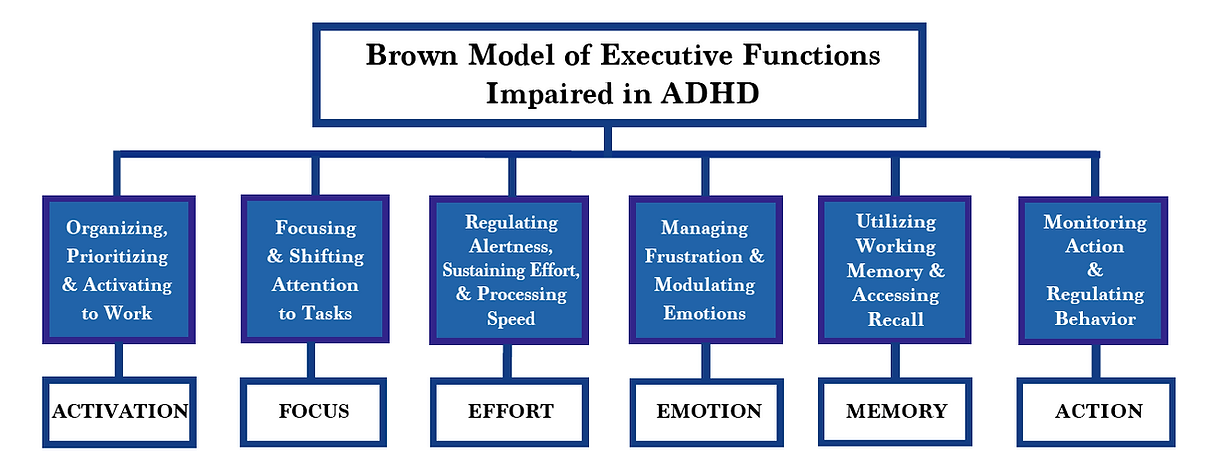 Dr. Thomas E. Brown developed a model showing how ADHD impairs various EFs crucial for academic success. There
are six clusters of skills: activation, focus, effort, emotion, memory, and action. Students with ADHD may have
issues in one or more of these six areas.
Dr. Thomas E. Brown developed a model showing how ADHD impairs various EFs crucial for academic success. There
are six clusters of skills: activation, focus, effort, emotion, memory, and action. Students with ADHD may have
issues in one or more of these six areas.
Anxiety & Stress
 The American Psychological Association defines anxiety as “an emotion characterized by feelings of tension,
worried thoughts, and physical changes like increased blood pressure” (APA, n.d.).
They define stress as “a normal reaction to everyday pressures” (APA, n.d.). The
difference between the two is the presence of a trigger – stress can be triggered by any situation you are
nervous or frustrated about. When the situation is resolved, the stress goes away. Anxiety does not need a
trigger. According to Healthline, if you can tie your feelings to a specific trigger, they are probably the
result of stress. If you can’t, or your symptoms persist after the trigger goes away, it may be anxiety. Both
stress and anxiety can become unhealthy if they affect your day-to-day life.
The American Psychological Association defines anxiety as “an emotion characterized by feelings of tension,
worried thoughts, and physical changes like increased blood pressure” (APA, n.d.).
They define stress as “a normal reaction to everyday pressures” (APA, n.d.). The
difference between the two is the presence of a trigger – stress can be triggered by any situation you are
nervous or frustrated about. When the situation is resolved, the stress goes away. Anxiety does not need a
trigger. According to Healthline, if you can tie your feelings to a specific trigger, they are probably the
result of stress. If you can’t, or your symptoms persist after the trigger goes away, it may be anxiety. Both
stress and anxiety can become unhealthy if they affect your day-to-day life.
ADHD + Anxiety & Stress

Anxiety is one of the most common comorbidities in teens and college students with ADHD, especially for girls (Mattingly, 2023). People with ADHD are more likely to have an anxiety disorder than people without ADHD, with rates approaching 50 percent (Kessler, et.al.,2006). The challenges of living with ADHD can sometimes make stress become out of control. And stress and anxiety can make EF challenges even worse.
Impacts of Anxiety & Stress by EF Areas
Activation
 For students with ADHD, challenges with activation include trouble organizing, prioritizing, and
starting work. They may struggle with organizing materials and schedules, leading to cluttered workspaces,
misplaced assignments, and missed deadlines. They may find it hard to identify the most important or urgent
tasks, leading to inefficiency and difficulty keeping up with work. They may have trouble getting started on
assignments, procrastinating or avoiding boring or difficult tasks.
For students with ADHD, challenges with activation include trouble organizing, prioritizing, and
starting work. They may struggle with organizing materials and schedules, leading to cluttered workspaces,
misplaced assignments, and missed deadlines. They may find it hard to identify the most important or urgent
tasks, leading to inefficiency and difficulty keeping up with work. They may have trouble getting started on
assignments, procrastinating or avoiding boring or difficult tasks.
Stress and anxiety can compound these issues by overwhelming cognitive functioning. Anxious students may
hyper-focus on immediate concerns or perceived threats, unable to step back and assess priorities objectively.
Overwhelmed by worry, perfectionism, or volume of work, they find it challenging to manage academic
responsibilities. Feeling anxious about an outcome or fearing failure, they may experience paralysis - too
frozen with fear to do anything. This can result in last-minute cramming, rushed work, or giving up and not
turning in assignments at all.
Focus
 Challenges with focus include difficulties sustaining attention and shifting attention between tasks.
Students with ADHD may have trouble filtering distractions and maintaining focus for extended periods, especially
on uninteresting tasks. They may have issues with transitioning, becoming stuck on a task, or being unable to
disengage from interesting or entertaining activities.
Challenges with focus include difficulties sustaining attention and shifting attention between tasks.
Students with ADHD may have trouble filtering distractions and maintaining focus for extended periods, especially
on uninteresting tasks. They may have issues with transitioning, becoming stuck on a task, or being unable to
disengage from interesting or entertaining activities.
Stress and anxiety can interfere with concentration and attention. This impacts the ability to engage with
lectures, complete readings, and study effectively. Students’ minds may become preoccupied with worries or
intrusive thoughts, and wander more frequently, making it challenging to focus on the current task. This can
lead to missed information, incomplete notes, and decreased productivity. Anxious students may become fixated on
specific tasks or worries, making it challenging to transition to new tasks or adjust their focus. This can
result in inefficiency, missed deadlines, and feelings of frustration or overwhelm.
Effort
 Challenges with effort include issues with regulating alertness and sustaining work. Many students
with ADHD experience chronic difficulty regulating sleep and alertness. They may have trouble falling asleep, s
taying asleep, and/or waking up. Lack of quality sleep leads to forgetfulness and difficulty
concentrating during classes or while studying.
Challenges with effort include issues with regulating alertness and sustaining work. Many students
with ADHD experience chronic difficulty regulating sleep and alertness. They may have trouble falling asleep, s
taying asleep, and/or waking up. Lack of quality sleep leads to forgetfulness and difficulty
concentrating during classes or while studying.
Sustaining effort over long periods can be challenging for students with ADHD. They may lose motivation,
becoming bored or frustrated with repetitive or demanding tasks, which leads to procrastination or task avoidance.
Students may also experience delays in processing speed, leading to difficulties completing tasks efficiently or
keeping pace with classroom instruction.
When students with ADHD are stressed or anxious, their ability to regulate alertness becomes further
compromised – they shift between hyperfocus and distractibility. They may miss important information during
lectures, have difficulty staying engaged in study sessions, or experience inconsistent performance on academic
tasks. They may become overwhelmed and exhausted by academic expectations or deadlines,
making it difficult for them to
stay focused and motivated enough to keep trying. Their attention wavers, affecting the ability to process
information quickly and accurately. Rumination or intrusive thoughts can further slow processing speed, leading
to incomplete work or subpar performance.
Emotion
 Challenges in this cluster include managing frustration and modulating emotions. Students with ADHD
often struggle with managing emotions, especially those due to academic challenges or setbacks. They can easily
be overwhelmed by difficult tasks or obstacles, leading to frustration, irritability, or anger.
Challenges in this cluster include managing frustration and modulating emotions. Students with ADHD
often struggle with managing emotions, especially those due to academic challenges or setbacks. They can easily
be overwhelmed by difficult tasks or obstacles, leading to frustration, irritability, or anger.
Stress and anxiety can intensify emotional challenges, triggering feelings of exasperation, overwhelm, or
hopelessness. Students may find it challenging to cope with academic pressures, interpersonal conflicts, or
setbacks, further impacting their mental health and academic performance. They may exhibit mood swings,
impulsivity, or emotional over-reactivity in response to frustrations, and may find it hard to maintain
composure. They may become more prone to impatience or angry outbursts, hindering their ability to problem-solve
or persevere through academic challenges. Becoming overwhelmed by negative emotions can lead to task avoidance
or emotional shutdown, impairing their ability to engage in academic tasks, interact with peers and teachers,
or seek help when needed.
Memory
 Challenges with memory include utilizing working memory and accessing recall. Working memory allows
students to temporarily hold and manipulate information in their minds. Students with ADHD often struggle with
working memory deficits, which can interfere with following multi-step instructions, remembering important
details, organizing their thoughts, or solving problems. Accessing recall is the ability to retrieve necessary
information from long-term memory. Students may experience issues in this area, leading to forgetfulness and
difficulty retrieving words and other learned information.
Challenges with memory include utilizing working memory and accessing recall. Working memory allows
students to temporarily hold and manipulate information in their minds. Students with ADHD often struggle with
working memory deficits, which can interfere with following multi-step instructions, remembering important
details, organizing their thoughts, or solving problems. Accessing recall is the ability to retrieve necessary
information from long-term memory. Students may experience issues in this area, leading to forgetfulness and
difficulty retrieving words and other learned information.
In stressed or anxious students, working memory capacity may become overwhelmed, making it difficult to retain
and manipulate information effectively. Students may struggle to comprehend complex instructions, synthesize
information from lectures or readings, or recall relevant details during exams. Stress and anxiety can impede
recall by interfering with retrieval processes and increasing interference from irrelevant information. This can
lead to difficulties in accurately completing assignments, understanding course material, or demonstrating
knowledge on quizzes and exams. The ability to recall information may be compromised, leading to memory blanks
or difficulty retrieving specific details.
Action
 Students with ADHD often struggle with monitoring their actions and maintaining task-related behaviors.
They may have difficulty staying on track, following instructions, or self-regulating their behavior in the
classroom or during independent study. They may grapple with impulsivity or hyperactivity, interrupting others
or blurting out answers. They may act out without considering consequences or struggle to control their
actions and emotions in social or academic settings.
Students with ADHD often struggle with monitoring their actions and maintaining task-related behaviors.
They may have difficulty staying on track, following instructions, or self-regulating their behavior in the
classroom or during independent study. They may grapple with impulsivity or hyperactivity, interrupting others
or blurting out answers. They may act out without considering consequences or struggle to control their
actions and emotions in social or academic settings.
Stress and anxiety can exacerbate impulsivity by increasing emotional reactivity and decreasing impulse control.
This can lead to hasty decision-making, procrastination, or engaging in flawed coping strategies - like
substance abuse - to alleviate stress. When students feel stressed or anxious, their attention may become
fragmented, making it difficult to stay focused on a task or effectively monitor their progress. Overwhelmed
by academic demands or external distractions, they may use procrastination, avoidance, or withdrawal as a means
of managing stress or anxiety. This can result in decreased productivity and increased errors.
Strategies to Combat Stress and Anxiety
So, what can anxious or stressed students do to keep their EF working well enough to stay on track and be successful? Here are several things you can try – see if any will work for you!
Re-Think
 How you think and act can transform your experience of stress. Short-term stress can motivate you, focus your
energy, and enhance your performance. Long-term stress is harmful to your health. It exhausts you, and leads
to anxiety, confusion, poor concentration, and decreased performance. Choose to view your stress in a different
way. Remind yourself that not all stress is bad. Reframing your thinking to “stress is helpful” can limit its
negative effects. By acknowledging and reframing your feelings, you can learn to manage anxiety in healthy
ways. If you are trying something new and worried about looking foolish or not being good at it, try telling
yourself “I’m willing to feel unsure. I can get up my courage and try this” (Saline, 2022).
How you think and act can transform your experience of stress. Short-term stress can motivate you, focus your
energy, and enhance your performance. Long-term stress is harmful to your health. It exhausts you, and leads
to anxiety, confusion, poor concentration, and decreased performance. Choose to view your stress in a different
way. Remind yourself that not all stress is bad. Reframing your thinking to “stress is helpful” can limit its
negative effects. By acknowledging and reframing your feelings, you can learn to manage anxiety in healthy
ways. If you are trying something new and worried about looking foolish or not being good at it, try telling
yourself “I’m willing to feel unsure. I can get up my courage and try this” (Saline, 2022).
Practice Self-Care
 To reduce stress, take care of yourself. Improve your sleep hygiene so you get more and better sleep. Fuel your
body with protein, fruits, and vegetables. Stay hydrated. Add some exercise to your daily routine, even a short
walk will help. Try to get outside into nature. Research shows that just 20 minutes in nature can significantly
lower your stress hormone levels. If you can’t get outside, listening to the sounds of nature helps your brain
get to a calm state. Try practicing mindfulness or meditation. When panicked or highly stressed, your breathing
becomes shallow and fast. Stop and do some deep breathing to calm yourself.
To reduce stress, take care of yourself. Improve your sleep hygiene so you get more and better sleep. Fuel your
body with protein, fruits, and vegetables. Stay hydrated. Add some exercise to your daily routine, even a short
walk will help. Try to get outside into nature. Research shows that just 20 minutes in nature can significantly
lower your stress hormone levels. If you can’t get outside, listening to the sounds of nature helps your brain
get to a calm state. Try practicing mindfulness or meditation. When panicked or highly stressed, your breathing
becomes shallow and fast. Stop and do some deep breathing to calm yourself.
Focus on the Present
 Don’t dwell on the past or worry about the future. Keep your mind in the present! If you are worried about
something, is there anything you can do about it? No? Then worry does you no good. Yes? Then do something about
it! Take a step towards solving your problem. Many of our anxieties are around things we have no control over.
So, worrying about them has no benefit. Try and let it go.
Don’t dwell on the past or worry about the future. Keep your mind in the present! If you are worried about
something, is there anything you can do about it? No? Then worry does you no good. Yes? Then do something about
it! Take a step towards solving your problem. Many of our anxieties are around things we have no control over.
So, worrying about them has no benefit. Try and let it go.
Speak Up
 Don’t suffer in silence – talk to someone! Chat with a friend, family member, counselor, health professional, or
coach about what is bothering you. Don’t be afraid to talk to your professors if you have questions or need help
or an extension.
Don’t suffer in silence – talk to someone! Chat with a friend, family member, counselor, health professional, or
coach about what is bothering you. Don’t be afraid to talk to your professors if you have questions or need help
or an extension.
Build Resilience
 Resilience is the ability to bounce back when things go wrong. Resilient people take the loss, recover from it,
and move on. They are good at adapting to change and rolling with the punches. They develop strategies to cope
with whatever is thrown their way. They learn from their mistakes, adjust their approach, and try again. This can
take some mental reframing. Say you fail an exam. Think about it logically, not emotionally. What strategies
did you use to study? How could you have studied differently? What did you learn about yourself? About the exams
in this class? Which questions did you get right and wrong – any patterns? What can you do differently next
time? Don’t think “I can’t do this”, think “I can’t do this YET.”
Resilience is the ability to bounce back when things go wrong. Resilient people take the loss, recover from it,
and move on. They are good at adapting to change and rolling with the punches. They develop strategies to cope
with whatever is thrown their way. They learn from their mistakes, adjust their approach, and try again. This can
take some mental reframing. Say you fail an exam. Think about it logically, not emotionally. What strategies
did you use to study? How could you have studied differently? What did you learn about yourself? About the exams
in this class? Which questions did you get right and wrong – any patterns? What can you do differently next
time? Don’t think “I can’t do this”, think “I can’t do this YET.”
Final Thought
Using Brown’s model of EF impairments in ADHD, we can appreciate how stress and anxiety exacerbate the cognitive, emotional, and behavioral challenges faced by students. It is essential to learn and practice stress management techniques and self-care practices to empower students with ADHD to thrive academically and personally despite the EF challenges they may face.
Images:
Brain mechanisms: https://rehametrics.com/en/executive-functions/
Brain liftng weights: https://imgflip.com/memetemplate/440553023/Happy-Brain
Brown Model of ADHD Impairments: https://www.brownadhdclinic.com/the-brown-model-of-add-adhd
Man with Head in Hands: https://www.klarityclinic.com/blog/5-signs-your-anxiety-is-problematic
Stressed woman: https://focusedmindadhdcounseling.com/adhd-can-cause-anxiety/
Girl with book on head: https://www.brandeis.edu/global/student-insights/mental-health.html
Magnifying Glass: https://womansworthconference.wordpress.com/2019/03/04/focus-is-the-real-mvp/
Pushing rock uphill: https://www.strengthforlife.us/post/the-power-of-effort
Emoji faces: https://discoverymood.com/blog/how-to-combat-overwhelming-emotions/
memory post-it note: https://www.psychologytoday.com/us/blog/the-young-and-the-restless/201411/case-the-malleable-memory
Action movie clapboard: https://satishrao.in/3-steps-action-oriented-win-war-within/
Rethink lightbulb: https://www.flaticon.com/free-icon/rethink_9537351
Selfcare image: https://lafayettefamilyymca.org/3-ways-to-practice-self-care/
Smiley face: https://www.buttonmuseum.org/buttons/dont-worry-be-happy
Speak up: https://hrdailyadvisor.com/2020/07/17/what-is-a-speak-up-culture/
Resiliense sign: https://centerforresilientchildren.org/home/about-resilience/
Specific questions and topic suggestions can be emailed to questions@ADHDinCollege.com.